
2025 Best of Florida Award
★★★★★
4.9 · 390+ Google Reviews
Our Doctors
Dr. Jessica Nixon & Dr. Ryan Garske
University of Maryland School of Dentistry
Flexible Payment Options
CareCredit · Dental Wellness Savings Plan
Most major PPO insurance accepted
Book an Appointment

>

>

>

Dental Sealants in Orange Park, FL

Dental Sealants in Orange Park, FL

Cavities do not announce themselves. They develop quietly in the deep grooves and pits of the back teeth, where toothbrush bristles rarely reach and where food and bacteria accumulate between visits. For children and adults who are prone to decay, that vulnerability is a constant concern. Dental sealants address it directly by placing a thin protective coating over the chewing surfaces of the molars before decay has a chance to start, giving teeth a barrier that brushing alone cannot provide.

At Orange Blossom Dentistry in Orange Park, Drs. Jessica Nixon and Ryan Garske recommend sealants as part of a proactive approach to preventive care for patients of all ages, with particular attention to children and teenagers during the cavity-prone years. As a family-owned practice built on long-term relationships, we see the difference that early protection makes. Our approach to general dentistry prioritizes preventing problems before they require costly, uncomfortable treatment.

What Dental Sealants Are and How They Work

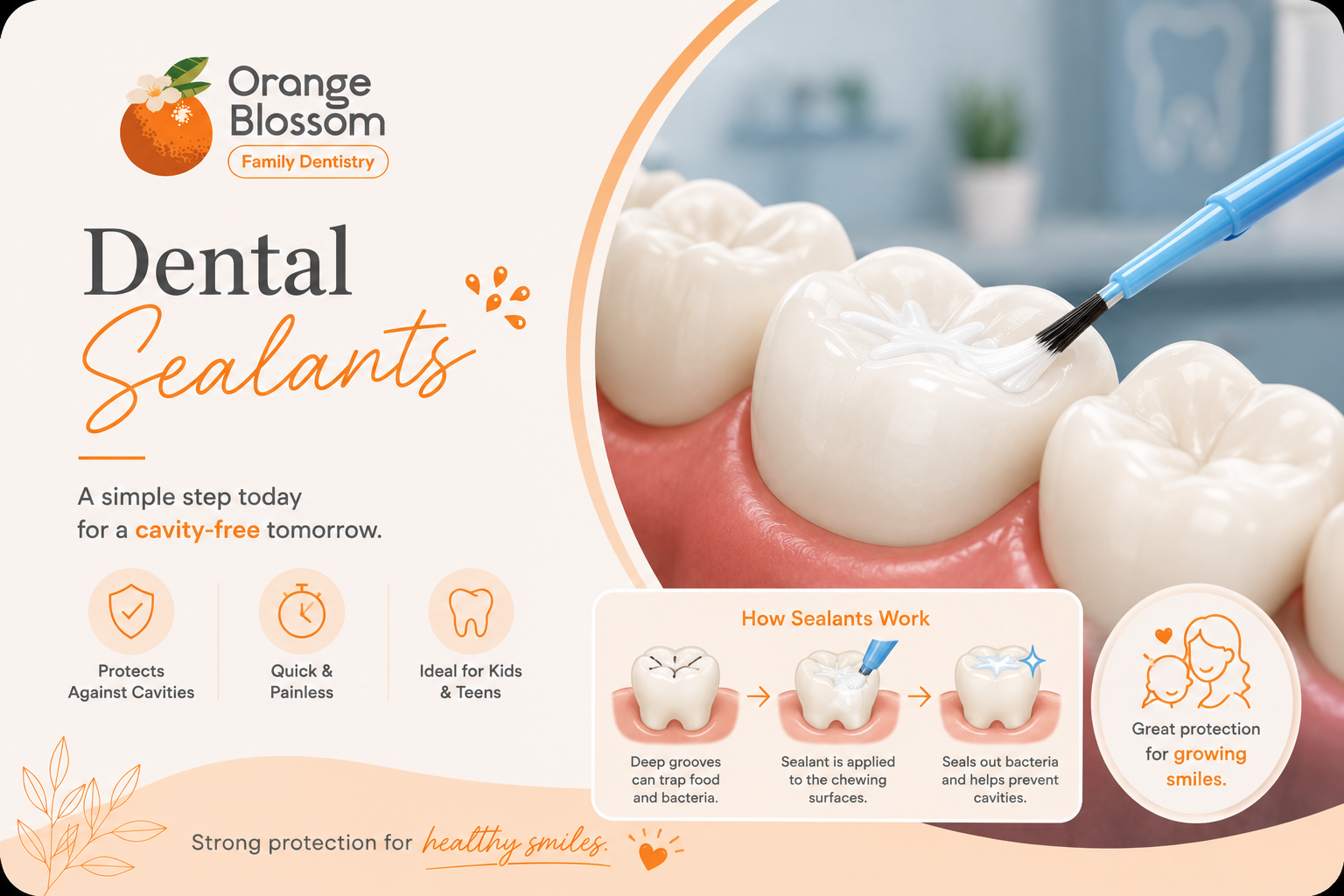
A dental sealant is a thin, tooth-colored or clear plastic coating applied to the chewing surfaces of the back teeth, specifically the premolars and molars. These teeth have deep grooves and fissures that are difficult to clean thoroughly, making them the site where the majority of cavities develop. Sealants flow into those grooves and bond directly to the tooth surface, creating a smooth, sealed barrier that prevents food particles and bacteria from getting in.

The application process is quick and entirely painless. The tooth is cleaned, conditioned with a mild solution to help the sealant adhere, and then the material is applied and hardened with a curing light. No drilling or anesthesia is involved. Here is what the process looks like from start to finish:
1
Clean the Tooth
The tooth surface is thoroughly cleaned to remove any plaque or debris before treatment begins.
2
Condition the Surface
A mild conditioning solution is applied to help the sealant material bond securely to the enamel.
3
Apply the Sealant
The liquid sealant is painted onto the tooth surface, flowing into every groove and pit.
4
Cure with Light
A curing light hardens the sealant in seconds. The patient can chew normally right away — no downtime.

dental sealants at orange blossom

Who Benefits from Dental Sealants

While sealants are most commonly associated with children, they are not exclusively a pediatric treatment. The back teeth are most vulnerable during specific windows of development and throughout life whenever decay risk is elevated. The patients who benefit most include:

Children Ages 6–12
As first and second permanent molars come in, sealing them early protects them through the highest-risk decay years.
Teenagers
Past primary teeth but still building consistent hygiene habits — sealants provide a reliable layer of protection in the interim.
Cavity-Prone Adults
Adults with deep grooves in their back teeth who have not yet developed decay in those surfaces are strong candidates.

According to the CDC’s Morbidity and Mortality Weekly Report, children without sealants have nearly three times more cavities in their permanent first molars than children with sealants, and sealants prevent more than 80% of cavities in the back teeth where nine in ten cavities occur. Those are numbers worth taking seriously.

80%
of back-tooth cavities prevented by sealants
3x
more cavities in children without sealants vs. those with
5–10 yrs
typical sealant lifespan with normal care

Our pediatric dentistry patients are strong candidates for sealants, and we evaluate each child at their routine appointments to determine when the timing is right.

How Long Sealants Last

Sealants are durable but not permanent. With proper care and normal chewing function, they typically last five to ten years. We check sealants at every routine visit and can reapply or repair them if wear or chipping is detected. The goal is continuous coverage through the years when cavity risk is highest.

It is worth noting that sealants protect the chewing surfaces of the back teeth specifically. They do not replace fluoride treatments, good brushing technique, flossing, or regular dental cleanings and exams. They work as one layer of a complete preventive approach, not a substitute for it.

 With SealantsWithout Sealants
Back-tooth cavity riskReduced by over 80%Full exposure
First molar cavities (children)3x fewer3x more
Procedure requiredQuick, painless applicationFilling or crown if decay develops
Duration of protection5–10 years per applicationNo protection
CostLow preventive costHigher cost if cavities form

Sealants as Part of a Complete Preventive Plan

Sealants are most effective when they are part of a broader strategy for maintaining oral health. At Orange Blossom Dentistry, we work with patients and their families to build that strategy around their specific risk factors, hygiene habits, diet, and history of decay.

For patients who have been consistent with cleanings and exams but still find themselves battling cavities, sealants are often one of the first additional measures we recommend. Combined with fluoride treatment and tailored hygiene guidance, they can significantly shift a patient’s trajectory from reactive to preventive care. For families managing the oral health of multiple children, sealants provide a reliable, low-effort form of protection that runs quietly in the background between appointments.

We are proud to serve patients from across the Orange Park area through our family dentistry practice, and sealants are one of the services that families return to again and again as their children grow.
Protect Your Family’s Teeth Before Cavities Start
Drs. Nixon and Garske offer dental sealants for patients of all ages at our Orange Park office — a simple, painless step that pays off for years.

FAQs About Dental Sealants

What are dental sealants made of?
Dental sealants are made from a thin plastic or resin material that is applied in liquid form and then hardened with a curing light. The material bonds directly to the tooth surface, creating a smooth protective layer over the grooves and pits where cavities most commonly develop.
We typically recommend sealants when the first permanent molars come in, usually between ages 6 and 7, and again when the second permanent molars erupt around ages 11 to 13. We evaluate each child at their routine appointments and recommend sealants based on their individual cavity risk and tooth development.
No. Placing sealants is completely painless and does not require any anesthesia or drilling. The process involves cleaning the tooth, applying a conditioning solution, and then painting on the sealant material, which hardens in seconds under a curing light. Most patients describe it as easy and quick.
With normal chewing function and good oral hygiene, sealants typically last five to ten years. We inspect them at every routine visit and can reapply or repair them as needed. Early replacement is far less expensive than treating a cavity that develops in an unsealed tooth.
No. While children and teenagers are the most common candidates, adults with deep grooves in their back teeth who have not yet developed cavities in those areas can also benefit from sealants. We evaluate sealant candidacy for patients of all ages based on their individual decay risk.

Our Reviews

Dental Sealants at Orange Blossom Dentistry

Drs. Nixon and Garske both trained at the University of Maryland School of Dentistry and built a practice grounded in prevention. We believe the best dental outcomes come from staying ahead of problems, and sealants are one of the most straightforward, evidence-backed tools available to do that. As a husband-and-wife team, we treat your family the way we treat our own. You can learn more about our backgrounds on our meet the doctors page.

If you have questions about whether sealants are appropriate for your child or for yourself, we are happy to discuss it at your next visit. Contact our office to schedule an appointment at our Orange Park location, and we will help you build a preventive plan that keeps decay from getting a foothold.

Contact us to schedule