
2025 Best of Florida Award
★★★★★
4.9 · 390+ Google Reviews
Our Doctors
Dr. Jessica Nixon & Dr. Ryan Garske
University of Maryland School of Dentistry
Flexible Payment Options
CareCredit · Dental Wellness Savings Plan
Most major PPO insurance accepted
Book an Appointment

>

>

>

Oral Cancer Screening

Oral Cancer Screening in Orange Park, FL

Most people don’t think about oral cancer during a routine dental visit — and that’s exactly the point. At Orange Blossom Dentistry, oral cancer screening is built into every comprehensive exam we perform, so there’s nothing extra to schedule, nothing to worry about, and nothing to prepare for. You’re already here; we take care of it as part of looking after your whole health. According to the National Cancer Institute, an estimated 59,660 new cases of oral cavity and oropharynx cancers are expected to be diagnosed in the United States in 2025 — and catching any concerns early is precisely what these screenings are designed to do.

As the husband-and-wife team behind this practice, Dr. Ryan Garske and Dr. Jessica Nixon bring a thorough, education-first approach to preventive care. Both trained at the University of Maryland School of Dentistry, and they built Orange Blossom Dentistry around the idea that a good dentist catches problems early — before they become bigger, harder, or more expensive to address. Our dental cleanings and exams already set the foundation for your overall wellness, and oral cancer screening is one of the clearest expressions of that whole-health philosophy in action.

What the Screening Actually Involves

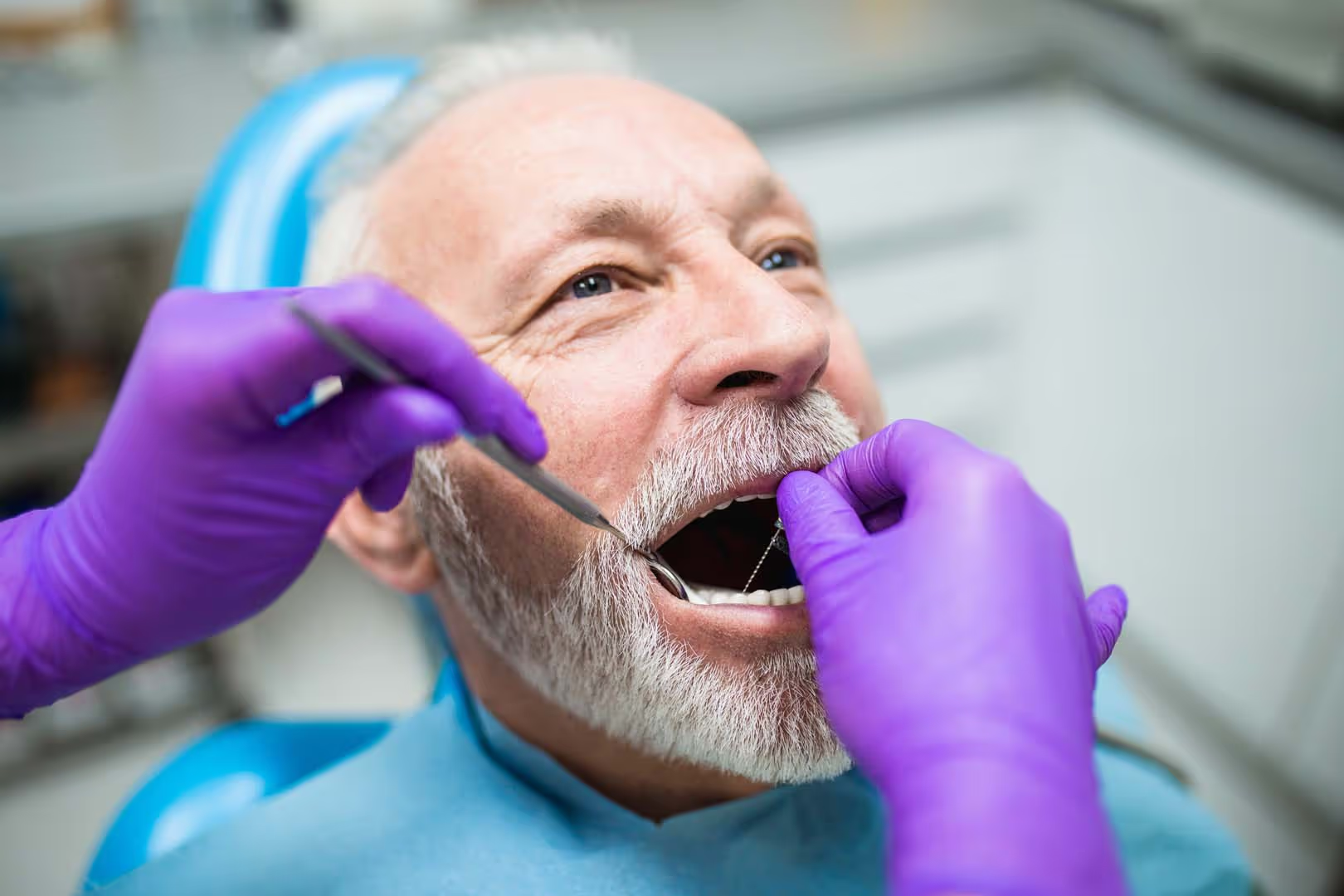
An oral cancer screening is a quick, painless visual and physical examination. There’s no discomfort, no special equipment to fear, and it adds only a few minutes to your visit. Dr. Garske or Dr. Nixon will look carefully at the soft tissues of your mouth and gently feel along your jaw and neck — the whole process follows three straightforward steps.

1
Visual Exam
Inspect lips, gums, tongue, cheeks, floor and roof of mouth, and throat for patches, sores, or unusual color.
2
Physical Check
Gently feel along the jaw and neck for any unusual swelling, lumps, or texture changes in the surrounding tissue.
3
Results & Next Steps
Most exams are completely clear. If anything warrants a closer look, we explain exactly what we found and what happens next.

In most cases, everything looks completely healthy and you leave with nothing more than peace of mind. In the rare instance something warrants a closer look, catching it at that stage is precisely where early screening makes a meaningful difference.
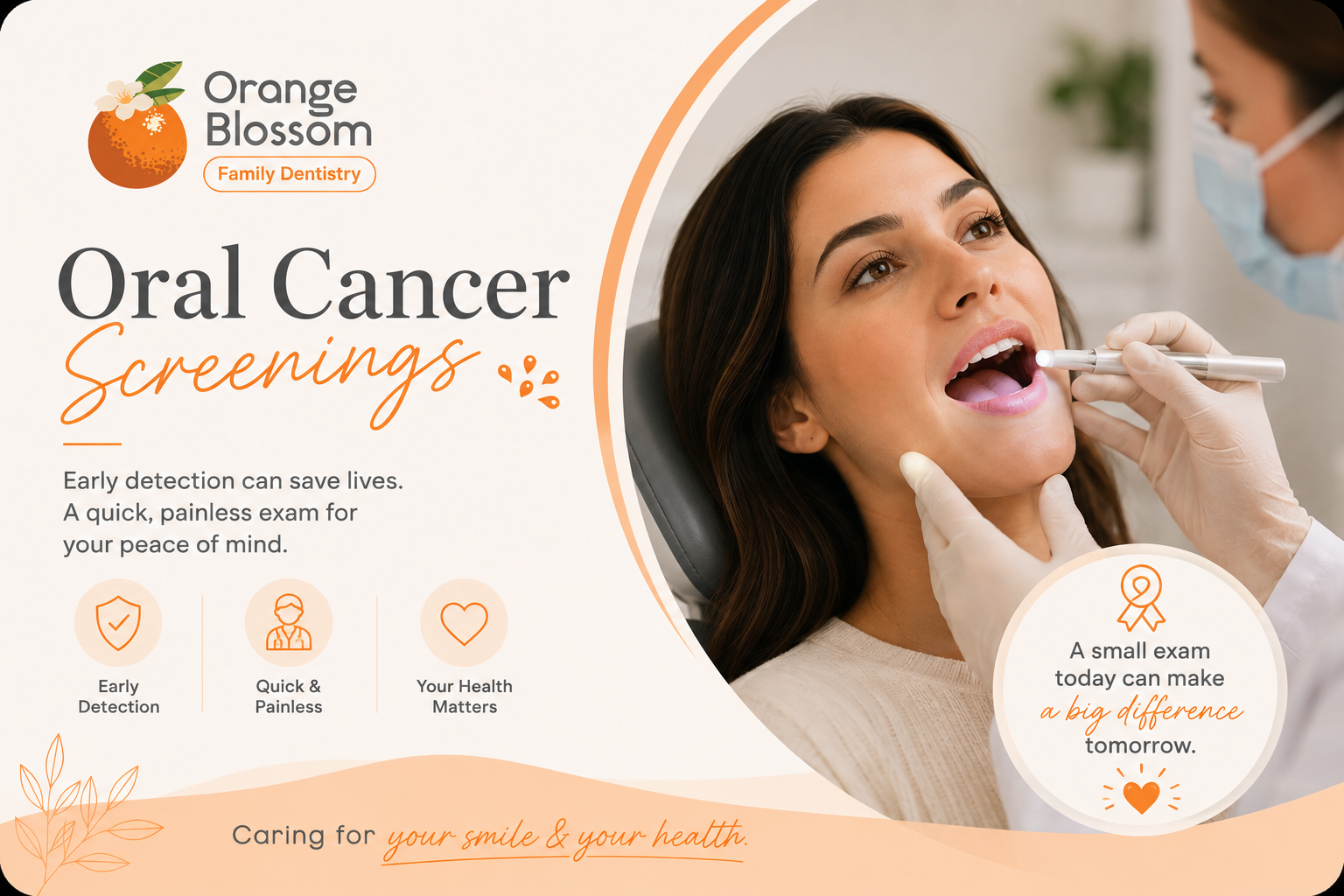
oral cancer screenings at orange blossom

Why Early Detection Matters

87.5%
5-year survival rate when caught early (localized stage)
37.8%
5-year survival rate when caught after the cancer has spread
59,660
New oral cavity & oropharynx cancer cases projected in the U.S. in 2025
40+ yrs
Orange Blossom Dentistry has served Orange Park and surrounding communities

The good news is that your dentist is one of the best-positioned healthcare providers to catch changes early. Because you’re already in the chair, and because the oral cavity is directly visible, regular checkups create a consistent opportunity to monitor changes over time. That’s not a scary proposition — it’s a simple, practical advantage of keeping up with your care.

Areas We Examine During a Screening

During every comprehensive exam, Dr. Garske and Dr. Nixon take a careful look at the following areas for any signs of change:

Lips & Corners
The outer lip line and corners of the mouth where early lesions often develop.
Gums & Cheeks
The gum tissue and inner lining of both cheeks, checked for color changes or texture irregularities.
Tongue
The top, underside, and sides of the tongue — areas where abnormalities are frequently missed.
Floor & Palate
The floor of the mouth and both the hard and soft palate at the roof.
Throat & Tonsils
The back of the throat and tonsil area, where HPV-related oropharyngeal cancers tend to arise.
Jaw & Neck
Felt externally for unusual swelling, lumps, or texture changes in the surrounding lymph nodes.

No single area is skipped, because early changes can appear anywhere in or around the oral cavity. The exam is designed to be thorough without adding meaningful time to your visit.

Risk Factors Worth Knowing

Oral cancer can affect anyone, but certain habits and exposures do raise the likelihood. The most well-established risk factors include the following — and many cases occur in patients with none of them at all.

🚬
Tobacco Use
Cigarettes, cigars, or chewing tobacco
🍷
Heavy Alcohol
Frequent or chronic alcohol consumption
🦠
HPV Exposure
Certain HPV strains increasingly linked to oral and oropharyngeal cancer
☀️
Sun Exposure
A risk factor for lip cancers specifically
📅
Age 40+
Historically higher incidence in older adults
⚠️
No Risk Factors
Many cases occur in patients with none of the above — screening applies to everyone

That picture has been shifting. HPV-related oral cancers have been rising among younger adults and women who don’t smoke or drink heavily. This is one reason we screen all of our patients as a standard part of family dentistry care, regardless of perceived risk level.

Warning Signs to Watch Between Visits

Oral cancer screenings are part of your regular visits, but you don’t have to wait for your next appointment if something doesn’t feel right. If you notice any of the following, call us promptly:

  • A sore in your mouth that hasn’t healed after two weeks
  • A white, red, or gray patch inside your mouth
  • Persistent pain or numbness in your tongue or mouth that has no clear cause
  • Difficulty swallowing that is new or unexplained
  • A lump or unusual thickening in your cheek or neck

These can have other, less serious explanations — but they’re always worth having evaluated. Catching something early is always better than waiting, and we’d rather take a look and find nothing concerning than have you wonder for weeks.

Our Technology Supports a Thorough Look

For cases that may benefit from additional imaging, Orange Blossom Dentistry has cone beam computed tomography (CBCT) technology in-house. This 3D imaging capability is typically only available at specialist offices, which means most patients would need a referral and a separate appointment to access it. Having it here means we can follow up on any area of concern without sending you somewhere else. We also use intraoral cameras during your exam, which allow us to show you exactly what we’re seeing in real time. Explore our full suite of dental technology to see what makes our diagnostic approach different from a typical dental office.

According to the National Cancer Institute, an inspection of the oral cavity is often a part of a physical examination in a dentist’s office, and visual examination remains the most common method used to detect oral lesions early.

Screening is already included in your next visit.

Nothing extra to schedule — just book your comprehensive exam.

SCHEDULE AN EXAM

FAQs About Oral Cancer Screening

Does oral cancer screening hurt?

Not at all. The screening is entirely visual and manual — Dr. Garske or Dr. Nixon will look carefully at the soft tissues in and around your mouth and gently feel along your jaw and neck. There’s no poking, no instruments, and no discomfort. Most patients don’t even realize the screening is happening until we tell them it’s done.

Because the screening is incorporated into every comprehensive exam, you’re being checked as often as you come in for your regular cleanings and exams. For most patients, that’s once or twice a year. If you have elevated risk factors such as tobacco use, heavy alcohol consumption, or a history of HPV, we may suggest coming in more frequently.

If we notice a tissue change that warrants a closer look, we’ll explain exactly what we’re seeing and what the next steps may be. In many cases, we’ll monitor the area over a short follow-up period since some changes resolve on their own. If we believe a referral or biopsy is appropriate, we’ll walk you through that process clearly so you’re never left guessing.

Oral cancer screening can identify suspicious tissue changes in the mouth and oropharynx, including areas where HPV-related cancers tend to develop. While the visual exam doesn’t test for HPV directly, it can flag abnormal tissue that may need further evaluation. This is one reason routine screenings are valuable even for patients who don’t consider themselves high-risk.

Yes. While tobacco and alcohol are the most commonly cited risk factors, a meaningful number of oral cancer cases occur in patients without those habits. HPV-related cases in particular have been increasing among people who don’t smoke or drink heavily. Routine screening is the responsible approach regardless of your lifestyle, and at Orange Blossom Dentistry it’s already included in every comprehensive exam you attend.

Our Reviews

Schedule Your Screening at Orange Blossom Dentistry

Orange Blossom Dentistry has been serving Orange Park and the surrounding communities of Fleming Island, Middleburg, and beyond for over 40 years. Dr. Garske and Dr. Nixon are the only two dentists here — there are no rotating providers, no associates cycling through. You see the same doctors and the same team at every visit, and that consistency is what allows us to notice when something has changed. Our state-of-the-art office combines advanced imaging technology with a warm, hometown approach to care that keeps patients coming back year after year.

Oral cancer screening is already built into your comprehensive exam — there’s nothing extra to schedule. Contact us online to book your next appointment today.

Contact us to schedule